How Does CBD Work in the Body?
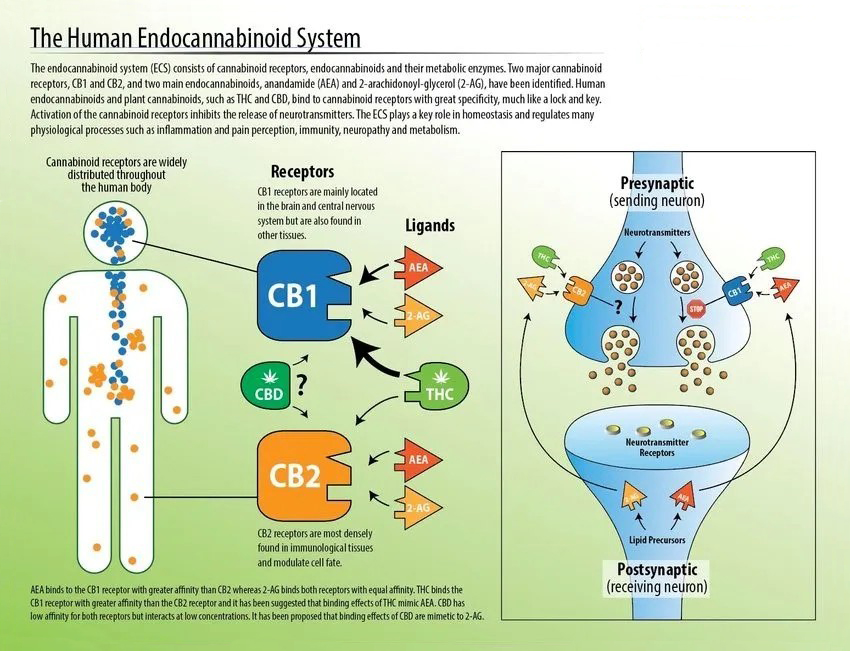
CBD interacts with the body’s endocannabinoid system (ECS), a regulatory system that plays a crucial role in maintaining homeostasis (internal balance) across various physiological processes, including pain, mood, appetite, sleep, and immune response.
Key Components of the Endocannabinoid System
Receptors: CB1 and CB2 receptors are the main ECS receptors.
– CB1 receptors: mainly located in the central nervous system; influence motor coordination, pain, appetite, memory, and mood.
– CB2 receptors: primarily found in the immune system; influence inflammation and pain.
Endocannabinoids: naturally produced compounds that activate cannabinoid receptors. The main ones are anandamide and 2-AG.
Enzymes: enzymes such as FAAH and MAGL break down endocannabinoids after they have fulfilled their function.
How Does Cannabidiol Act?
Interaction with receptors: CBD does not bind directly to CB1 and CB2 receptors but modulates their activity, increasing or reducing the effects of endocannabinoids or other compounds.
Enzyme inhibition: CBD can inhibit enzymes that degrade endocannabinoids, prolonging their effects in the body.
Serotonergic receptors: CBD also interacts with serotonin receptors (5-HT1A), contributing to its anxiolytic and antidepressant effects.
Vanilloid receptors: CBD can activate TRPV1 receptors, involved in pain and body temperature regulation.
What Does CBD Do to Our Body?
CBD helps the body when it is under stress and acts as a natural rebalancer. It is a natural ally in cases of insomnia, anxiety, stress, menstrual pain, migraine, and chronic pain.
CBD effects on the body: its action consists of interaction with our endocannabinoid system.
CBD Benefits
A 2021 survey on individuals suffering from cervical pain or other spinal disorders highlights how CBD, through its muscle-relaxant properties, may help make pain more tolerable. Unlike conventional drugs, CBD does not show evident risk factors or side effects; on the contrary, its benefits are clearly observed.
CBD benefits extend beyond simple pain relief. It has shown promise in reducing stress, dizziness, and nausea associated with neck pain. Furthermore, CBD health benefits also include relief from anxiety and depression, headaches, chronic pain management, seizure reduction, cervical hernia, and treatment of skin conditions such as acne, psoriasis, and eczema.
CBD Side Effects and Drug Interactions
CBD is often well tolerated, but it is not “just water.” Possible effects (varying by individual and dose) include:
- drowsiness or sedation
- gastrointestinal disturbances (e.g., diarrhea)
- dry mouth
- appetite changes
- fatigue
However, serious side effects are quite rare, and CBD is likely safe for most people, especially compared to many pharmaceuticals that carry significant contraindications.
CBD may potentially interact with certain medications, and these interactions can vary. Main drug groups include:
- Anticoagulants: CBD may increase bleeding risk when taken with drugs such as warfarin due to inhibition of liver metabolism.
- Anticonvulsants: CBD may alter plasma concentrations of other antiepileptic drugs, such as clobazam, enhancing both desired and undesired effects.
- Antidepressants: concomitant use with SSRIs such as sertraline or fluoxetine may alter effectiveness or elimination dynamics, increasing side-effect risk.
- Cardiac and antihypertensive drugs: CBD may have hypotensive or hypertensive effects depending on dose and context, influencing treatment efficacy.
- Sedatives and benzodiazepines: combined use may enhance sedative effects and increase excessive drowsiness risk.
- Pregnancy and breastfeeding: CBD use is not recommended.